Wednesday, 15 May 2013

Week 14- Personal


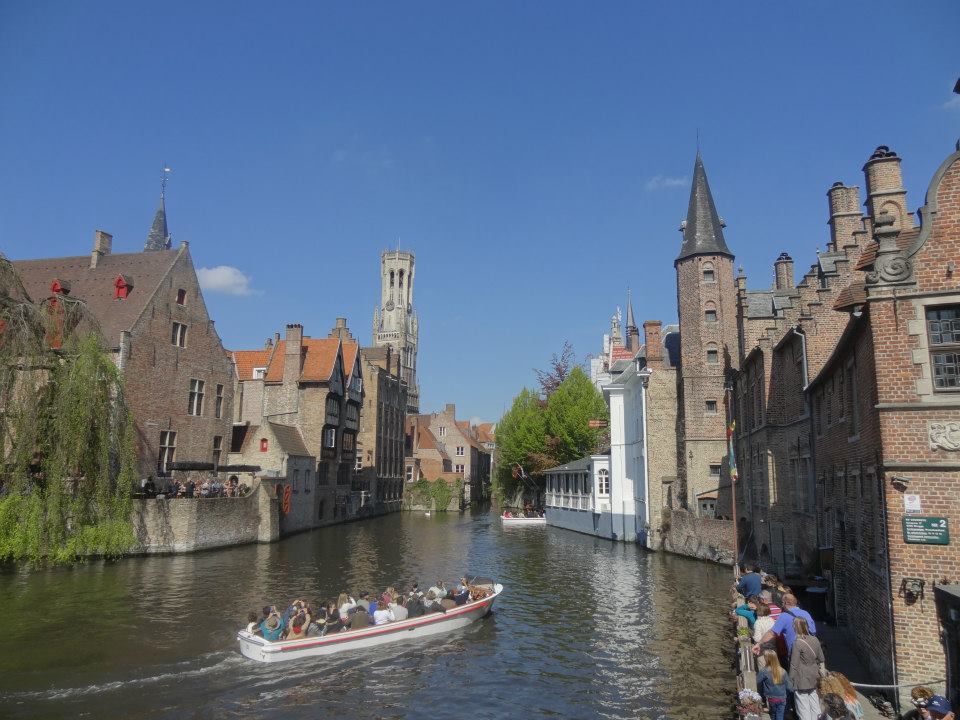
Canal in Bruges
During the weekend Sarah and I had decided to do some traveling before getting back in to the normal routine of university and placement.   We decided to spend the weekend in Bruges, Belgium.  On Saturday we set of on our journey to the train station and after a few hours traveling and three train changes we eventually ended up in Bruges.   My first impression of Bruges was that it was the most beautiful place I had ever seen in my entire life.  With the sun splitting the trees Sarah and I walked around Bruges in complete awe of its beauty.  According to Ucityguides (2013) Bruges is considered to be in the top 10 most beautiful cities in the world and it was easy to see this as we walked around it. From sparkling canals to medieval architecture it was an unforgettable experience and I would advise everyone if they had the change to visit Bruges to not pass by the opportunity.   

Bruges by night

After an amazing weekend spent exploring Bruges with Sarah it was time to prepare ourselves for our first ‘good-bye’ of Erasmus.  The week that we all had been dreading had finally crept up on us.  Jodie or ‘Dojo’ as she now was called would be leaving us on Tuesday and travelling back to Bordeaux.  We wanted Dojo to have the best last day ever so on Monday Darren, Sarah and I went into Nijmegen to get her the best leaving present ever.  We arrived back with a variety of different presents that described Dojo down to a tee and although it was very emotional to give her the presents we had some laugh when she revealed what each present was.  Then after a buffet dinner we sat up talking all night postponing goodbyes until at 4.30 am until we eventually had to let her get some sleep as  she was getting up at 7.00am to go the airport.  It wasn’t until late on Tuesday evening that it finally sunk in that she was gone and the whole flat was filled with a strange feeling.  However plans have been made to travel to Bordeaux in June so we are counting down the days until we are all reunited. 

The boy's favourite song
Spice up your life 
On Wednesday I travelled with Darren to Amsterdam to pick up his mum and dad.  It was great to here an accent from home and we filled them in on all the gossip that had been happening on Erasmus. When we arrived back to Nijmegen, Darren and his parents went out for dinner while I returned back to Vossenveld for a crazy night of Karaoke with our friends on the 8th floor.  With artist like Steps, The Spice Girls and Tom Jones being requested it was a great night full of laughs.  Darren even returned back early and along with Mikael and Olli (boys from Finland) provided us with endless laughs with their rendition of Barbie Girl. 

Our friend Ciara also returned to The Netherlands this week and it was great to have part of the family back.  As we were starting back to placement on Monday we decided to have a party on Saturday night to bring an end to our two week holiday.  On Saturday night we went to the 8th floor and partied together long into the night. It was a great end to our two week holiday.

References
Ucityguides (2013) Top 10 most beautiful cities in the world available at: http://www.ucityguides.com/cities/top-10-most-beautiful-cities.html (last accessed 13/05/13) 

Wednesday, 8 May 2013

Week 13 – Cultural


This week was the start of our two week holiday for May break.  This meant no placement, no classes and two weeks off to relax and enjoy the spring sunshine. 

Celebrating with some of the girls
Even though we were excited to have a few days off to relax the real excitement was brewing for a special occasion that was happening in The Netherlands.  This special occasion was Queen’s Day (Koninginnedag).  Queen’s day is a national holiday in The Netherlands that commemorates the birthday of the Queen.  The Dutch people have been celebrating Queen’s day on 30th April since 1949 when Queen Juliana was on the throne.  However the current Queen is Queen Beatrix who succeeded Juliana in 1980 but decided to keep Queen’s Day on April 30th (even though her own birthday is on 31st January).  One of the main reasons behind keeping the celebrations on April 30th was that there would be good weather for everyone to be able to enjoy the day outside in the sun.

Ever since we arrived in The Netherlands people had been talking about Queen’s Day and informing us about what happens on this day.  Based on what we had heard and pictures we had seen we thought that everybody dresses in Orange and everything turns into a big party to help the Queen celebrate her birthday (and yes we were right).  To add to the celebrations this was also going to be the last Queen’s Day for good few years as Queen Beatrix was stepping down from the throne allowing her son Willem- Alexander to become King. 

Some of our group all dressed up 
When the 30th of April arrived we all got up early and started the process of turning ourselves orange.  From orange clothes, to orange face paint to orange hair we all looked the part and were ready for a day full of celebrations (getting ready for the day ended up in a bundle of laughs when one of the boys painted himself all orange and then found out that the paint he had used may have been waterproof).   As this was a big day of celebrations in The Netherlands we decided not to go to Amsterdam because on a normal day Amsterdam is very busy never mind on one of the biggest celebrated day in Dutch culture.  Instead our Erasmus group decided to go to Eindhoven to celebrate the day.  When we arrived in Eindhoven we were amazed to see all the different activities that were taking place.  Everything and everyone was dressed in orange and there was music blasting from everywhere in the street.  It was amazing to see how everyone came together to celebrate such a special day.  It made me think about how people might feel when they come to Ireland and witness St. Patrick’s Day. 

The street in Eindhoven
We celebrated Queen’s day long into the night with the celebrations ending at the Canal beside Vossenveld.  It really was one of those experiences that I will never forget and as it was celebrated with an amazing group of people it will always remain one of my most cherished memories.  Dave Brenner states that “ Friends are the most important part of your life. Treasure the tears, treasure the laughter, but most importantly, treasure the memories”.


It was such a good day that we have even thought about coming back to the Netherlands to celebrate King’s Day in the future. 


References
Brenner, D. Available at: http://www.desktop-quotes.com/friendship-and-memories-quotes.html (last accessed 04/05/13)


Wednesday, 1 May 2013

Week 12 Personal


This week was a very special week for me as it was the week of my 21st birthday.  My birthday was on the 23rd of April (Tuesday) but as I wasn’t going to be at home to celebrate it our Erasmus group decided to start the celebrations early on Saturday.   Normally people say end your night with a bang but in our case our night started with a bang, a big bang which left Darren and I with some cuts to our hands and left my bike in the bike ziekenhuis (bike hospital) to get a new wheel put on.  None the less we continued on out and had an amazing pre-21st party.


Party Decorations
On the day of my birthday I went into my placement school.  We had our normal gym lesson in the morning and after it the children sang Happy Birthday to me in English and in Dutch.  Some of the children in my class had made posters for my birthday while other children had brought in some cupcakes for me.  After school I returned back to my flat where I screamed with excitement when I saw that our kitchen had been completely decorated with 21st birthday banners and balloons. 


From the PowerPoint
All during the week I had been receiving presents and cards from home which I had promised not to open until my birthday so you can imagine my excitement when the day finally arrived to open them.   As if my day couldn’t get any better I was then surprised again when I went into our kitchen to find our Erasmus group sitting around a table full of presents for me and a chocolate and strawberry cake.  Now I’m not one to get emotional but the fact that all these people who didn't even know me three months ago (apart from Darren and Sarah) went to so much effort for my birthday brought some tears to my eye, and to make matters worse one of my flatmates had prepared a PowerPoint especially for my birthday which just made the happy tears flow. One of  the items that really did pull at my heartstrings was a signed photo frame, this is something that will always remain special to me and will always make me think of Erasmus Nijmegen 2013. At the time I couldn't thank them all enough for making the day so special for me (Darren and Sarah really outdid themselves) however the next morning I wasn't so keen on thanking them for the after effects of the party.

All my amazing gifts 


Family dinner 
Although the start of this week was amazing the end of the week had a different sort of feel to it.  On Friday we had our last Erasmus family dinner together as our French friend Jodie is now coming to the end of her 3 month Erasmus. Although Jodie isn’t leaving for another few days some of our friends are going back home for May break so our dinner was the last time that we would all be together for a while.  Although we had an amazing dinner it was strange thinking that we would be missing a member of our family for our last two months of our Erasmus.  The days have been creeping in on us and it seems like just yesterday that we had shared a taxi with Jodie the very first day we landed here.  Even in just three months we have created memories that will last forever and as Harriet Morgan (2013) states “A memory lasts forever, never will it die.  True friends stay together and never say goodbye”.   So when it comes to the day that Jodie has to leave, we know that it won’t be a goodbye but a great big “see you later”.

References


Monday, 22 April 2013

Week 11 Professional

During this week we had no scheduled classes but we were given the opportunity to attend extra workshops that would add ECTS to our overall mark for Erasmus.  The workshops were taught by international lecturers from St. Patricks College (Dublin), Dokuz Eylul University in Turkey and Georgia State University in Atlanta.  We had to choose two out of the tree workshops to attend which looked at the topics of Bullying, Educational Disadvantage and Drama. The workshops that we choose to attend were Educational Disadvantage and Bullying which were presented by the lecturers from Ireland and the USA.

On Tuesday we went to the first of three lectures based on Educational Disadvantage.  We were then told that this workshop would look at how The Arts can be used as a technique to help tackle educational disadvantage in primary schools.  The breakdown of the course enabled us to explore the status of The Arts in the different countries and it allowed us to begin to talk about why The Arts may have such a high status in some countries and not in others.  We then talked about how harnessing multiple intelligence profiles can aid in tackling the fear of failure in children.  We were told that by preparing lessons that suits a child’s intelligence profile allows them to succeed in every way.  CCEA (2007, p. 27) states that in Foundation Stage ‘Children’s creative, expressive and physical development is closely linked with all aspects of their learning’ we got to see this when we were showed how children can become creative agents in their own learning as they take full control of their learning in The Arts.  CCEA (2007, p.69) also states that at Key Stage 1 and 2 ‘Art and Design, Drama and Music provide rich opportunities for developing creativity, allowing children to express their ideas, feelings and interpretations of the world in diverse ways”. This was backed up when the lecture gave us information on a recent study that she had completed. Children in her study were presented with the task of designing their dream school and all children were able to come up with an individual idea and present it to the rest of the class. 

The bullying workshop got us to look at the problems of bullying in schools in America and to think about if we have seen any bullying happening during all our different placements.  NVPEP (2009) states that ‘more than 160,000 US students stay home from school each day from fear of being bullied’. We were given a survey to fill in that asked questions about if schools in our home countries had bullying policies and it was very interesting to find that most other countries do not have a bullying policy. The NIABF (2013) states that ‘43% of primary school children perceive that they have been bullied at least once’. After we discussed what bullying means our lectures then gave us a case study on bullying in which we had to work in groups to come up with different solutions to combat the  issue of bullying using Direct and Indirect Punitive responses and Direct and Indirect constructive responses.  The lecture’s finished off by showing us a 7 week scheme of work that address the issue of bulling which enables the teacher to find out places that the children think are safe and unsafe in the school grounds.  This was very interesting to see as the lectures said that by using this map of the school both students and teachers were able to work together to make the school a safer environment for all students.    


This week was very interesting and made me think about my professional career and the different topics and issues that I will have to combat once I become a qualified teacher.

References

CCEA (2007) Northern Ireland Curriculum, Belfast, CCEA.

NevadaPEP (NVPEP) (2009) Bullying Statistics Did you know? Available at: http://www.nvpep.org/bullying/bullyingstatistics.html (accessed 22/04/13)

Northern Ireland Anti-Bullying Forum (NIABF) (2013) About Bullying available at:  http://niabf.org.uk/index.php?option=com_content&task=blogsection&id=5&Itemid=29 (accessed 22/04/13) 

Tuesday, 16 April 2013

Week 10 Cultural

This week we took part in the ‘Tour to the West’ which is a compulsory component of our Dutch Culture and Society Module.  The ‘Tour to the West’ is a weekend trip that enables us to visit other cities in the West of the Netherlands.  During the trip we would be visiting the cities of Delft, The Hague and the up rooted village of The Zaanse Schans.

The famous Delft Porcelain
On Friday morning we left for the city of Delft, it was here that we would be taking part in a photography challenge that would help us to get to know the city better.  The first piece of information that we found out about Delft is that it is famous for its blue and white pottery.  The blue and white porcelain has been made in the city since the 1600s. There were many souvenir shops selling Delft pottery and around the city there were monuments and bricks made out of this blue and white porcelain.  The day continued with trips to both the Oude Kerk (Old Church) and the Nieuwe Kerk (New church) which included a 356 step climb up a 108.75 metre tower on the New church that gave us an amazing view of the city of Delft. 


Michelle and I on top of the Nieuwe Kerk
On Saturday we travelled to The Hague where we would be taking part in a treasure hunt to help us explore the city.  In The Hague we got to go and visit the ‘working palace’ of the of the Dutch Royal family.  This palace is called Noordeinde Palace and it is the Queen’s workplace and office for all political and affairs.

Noordeinde Palace

Sunday we left our hostel and travelled towards the Dutch heritage museum called Zaanse Schans.  The Zaanse Schans is a replicate village that shows how a typical Zaanse village would have looked like in the 17th and the 18th century; however it is still a functioning hamlet in which people live in. Our tour guide referred to the village as “the perfect way to view the historical heritage of The Netherlands”. 
Zaanse Schans


Trying on Green clogs

During our visit to the Zaans Schans village we were given a demonstration on how to make cheese and how to make wooden clogs.  I was really interested to see how clogs were made as they are something that I would consider ‘typically Dutch’.  The website Iamsterdam (2013) states that “clogs have even been certified by the European Union as safety shoes as they can withstand sharp and heavy objects and concentrated acids”. At the beginning I found this quite hard to believe but after the demonstration I was able to witness the strength of a clog.  During the demonstration it was fascinating to see all the different clogs that would have been used for different circumstances e.g. farming, family functions and even clogs for kids.  I also learnt that brides carved their own wedding clogs to make them individual and that they would wear them for the first time on their wedding day. During the demonstration we were told that it would take two hours to carve a pair of clogs by hand but now with the help of modern technology a pair of clogs can be created in under five minutes.

First Albert Heijn Grocery Store
After this we also got to see the first  ever ‘Albert Heijn’ grocery store , this was very fascinating to see as Albert Heijn at the moment the biggest supermarket chain in the Netherlands and it was very interesting to see where it all had originated.

Overall I had a great weekend at the ‘Tour to the West’, both night and day was filled with fun and adventure and it was a fantastic way to get to learn more about the culture and history of The Netherlands. 


References
Iamsterdam (2013) Clogs – Traditional Hand Crafted wooden shoes available at: http://www.iamsterdam.com/en-GB/experience/about-amsterdam/history-and-society/clogs accessed (15/04/13) 

Tuesday, 9 April 2013

Week 9 Professional

In school this week my teacher showed me how she plans what the children will be doing each week.  She explained to me that the school promotes independent learning throughout all the different age groups but that they also teach children time management and how to schedule their day.  She highlighted that this was particularly important for group eight (my class) as next year they will be attending secondary school and there they will need to be able to plan when to do homework and assignments for all the different classes that they will have.


The picture above shows the type of plan that my teacher and my class use each week.  The children get a plan like this every Thursday.  From the picture you can see that each day has a specific colour e.g. Vriidag (Friday) is orange.  You can see from the plan there are set lessons to be completed on certain days e.g. On Wednesday (Woensdag, Blue) the children have to do Rekenen pages 98 + 99 (Math), when the children complete this lesson they colour in the box beside Rekenen blue.  However you can see that some tasks do not have a colour beside it and that both boxes are white.  This means that the children can choose on what day they would like to complete these lessons.  The children have to think about what they will be able to achieve on that day and when would be the best time for them to do their extra work.  To allow the children to think carefully about their planning they get a special amount of time each week called ‘Blokuur’ which means ‘planning time’.  This type of development prepares the children for planning their homework and helps them think about time management and scheduling.
The GTCNI (2008) (competence number 13) states that “Teachers will plan and evaluate lessons that enable all pupils, including those with special education needs, to meet learning objectives/outcomes /intentions showing expectations and an awareness of potential areas of difficulty.”

I believe that this type of planning allows the teacher to enable all students to meet the learning objectives as the children will be working at their own pace and completing their extra work during a time that they have decided on themselves.  They still have to complete certain tasks that the teacher selects but by allowing the children to choose when they would like to complete work encourages them to be independent and think about their own level of ability.  Armathwaite Community School (2013) States that “asking children to plan and review what they do involves them purposefully in their own learning”.

Here in The Netherlands there is no curriculum that primary schools have to follow.  The teacher is able to choose what the children will learn and what type of books he/she would like to use to help the children learn.  My class learn Language (Taal) and Math (Rekenen) but the rest of the time they work on a specific project that the teacher would like to teach them.  Projects that the children have been working on since I have arrived are ‘Southern European Countries’ and they are currently working on ‘The Dutch Golden age’ (De Gouden Eeuw).  


References 
Armathwaite Community School (2013) Introduction: What is child Initiated Independent learning? Available at: http://www.armathwaite.cumbria.sch.uk/index.php?category_id=18 (accessed 06/04/13)

GTCNI Competences (2008). Professional Competences. Available at : http://www.gtcni.org.uk//index.cfm/area/information/page/ProfStandard (accessed 06/04/13)

Monday, 1 April 2013

Week Eight – Cultural

As we were off for our Easter break we decided to use this as an opportunity to go travelling.  After discussing about the different places that we could visit, our group all agreed that we would like to travel to Germany and see the capital of Berlin.

Map of the many wind farms across Germany
As I love to travel I was very excited that we would be getting to go and visit another country.  We set off on Thursday morning to the bus station where we would be getting on the first of many buses to Berlin.  I had no idea what to expect from Berlin but travelling with Darren and Sarah who are history nerds I got a brief history of Berlin during the 11 hours we travelled so I was well and truly educated by the time I arrived.  

The first thing I noticed when we entered Germany was the wind turbines.  According to Natural Geographic (1996) “Germany has the most installed wind energy capacity, followed by Spain, the United States, India, and Denmark”.   This was easy to see as every mile or so we would drive past a field that had around 10 wind turbines in it. It was incredible to see the amount of wind turbines across the landscape and it made me think about how some people back home would argue that it ruins the landscape but that in fact it is a great source of renewable energy.


Brandenburg gate


We arrived in Berlin late on Thursday night so we decided to have an early night to prepare for the adventure that would occur the next day.  We got up early on Friday morning and got the bus into the centre of Berlin, this is where the fun began.  We had to get hold of a map and figure out in what direction we would have to travel in to get to our first destination of the Brandenburg Gate.  It was when we arrived at the Brandenburg gate that it hit me that I was finally in Germany.   It was an amazing experience to stand at the gate and see the vast amount of people that crowded around it.  


Holocaust Memorial 
Dinosaurs at National History Museum

We then went on to visit the Reichstag, the Jewish Holocaust memorial, the contemporary art museum, the natural History museum, the Berlin Wall and the Berlin Wall museum. 


Memorial at the Berlin Wall
It was at the Berlin Wall that the history of Berlin really hit home for me.  There was a memorial of some of the people who had died at the wall and pictures of their faces.  It was seeing the faces of people who had died trying to get a better life that really made me think about the devastation that happened.  In the Berlin Wall museum we got to read about the history of the wall and about stories of people who had died trying to get over the wall including some children.  Some stories were very difficult to read about and also some of the videos that they were showing were hard to watch.  However it was an amazing experience and I learnt a lot from the stories and the different items that were on display.


"No man's land" between the East and the West
On Friday we visited a museum that showed 800 years of Berlin history from medieval times to the history of both world wars.  The amount of items from the different time periods that the museum had preserved was mind-blowing and it was incredible to see how Berlin had grown as a city.  Even though we spent two hours in the museum we didn't get to finish it as we also had to visit the Jewish museum, the Atle Nationalgalerie museum and Checkpoint Charlie that very same day.

Famous photograph
At Checkpoint Charlie I saw a famous photograph which I completely fell in love with.  It is a picture of an East German soldier leaning across a barrier talking to a small boy.  My first thoughts were what was the soldier doing and why was he talking to the young child.  I later found out that the history behind this picture was that young boy had spent the night with friends and found himself the next morning on the opposite side of the wall to his family.  The soldier is glancing around to see if it is safe to let the young boy pass through the barrier back to his family.  However the communist government had ordered the soldiers not to let anyone pass through the barriers so that explains the soldier’s apprehensive look.  The soldier was seen by his superior officer and was immediately detached from his unit.  The inscription beneath the photo reads that “No one knows what became of him” referring to the soldier.  Reed (2009) talks about the picture and states that “Only the most despicable tyrants could punish a man for letting a child get to his loved one but in the Evil Empire, that and much worse happened all the time” .

Berlin was an amazing experience for me and although we only got to stay there for four days I learned so much and got to experience so much of the German history and culture.  I would advise everyone if they had the opportunity to visit Berlin to take it as it is a breath taking and beautiful city. 

References
Natural Geographic (1996) Wind Power available at: http://environment.nationalgeographic.com/environment/global-warming/wind-power-profile/ (accessed 29/03/13)
Reed, L. (2009) Berlin, August 1961: An Anniversary We Should Never Forget available at: http://www.fee.org/the_freeman/detail/berlin-august-1961-an-anniversary-we-should-never-forget (accessed 29/03/13)